Monday, November 23, 2015

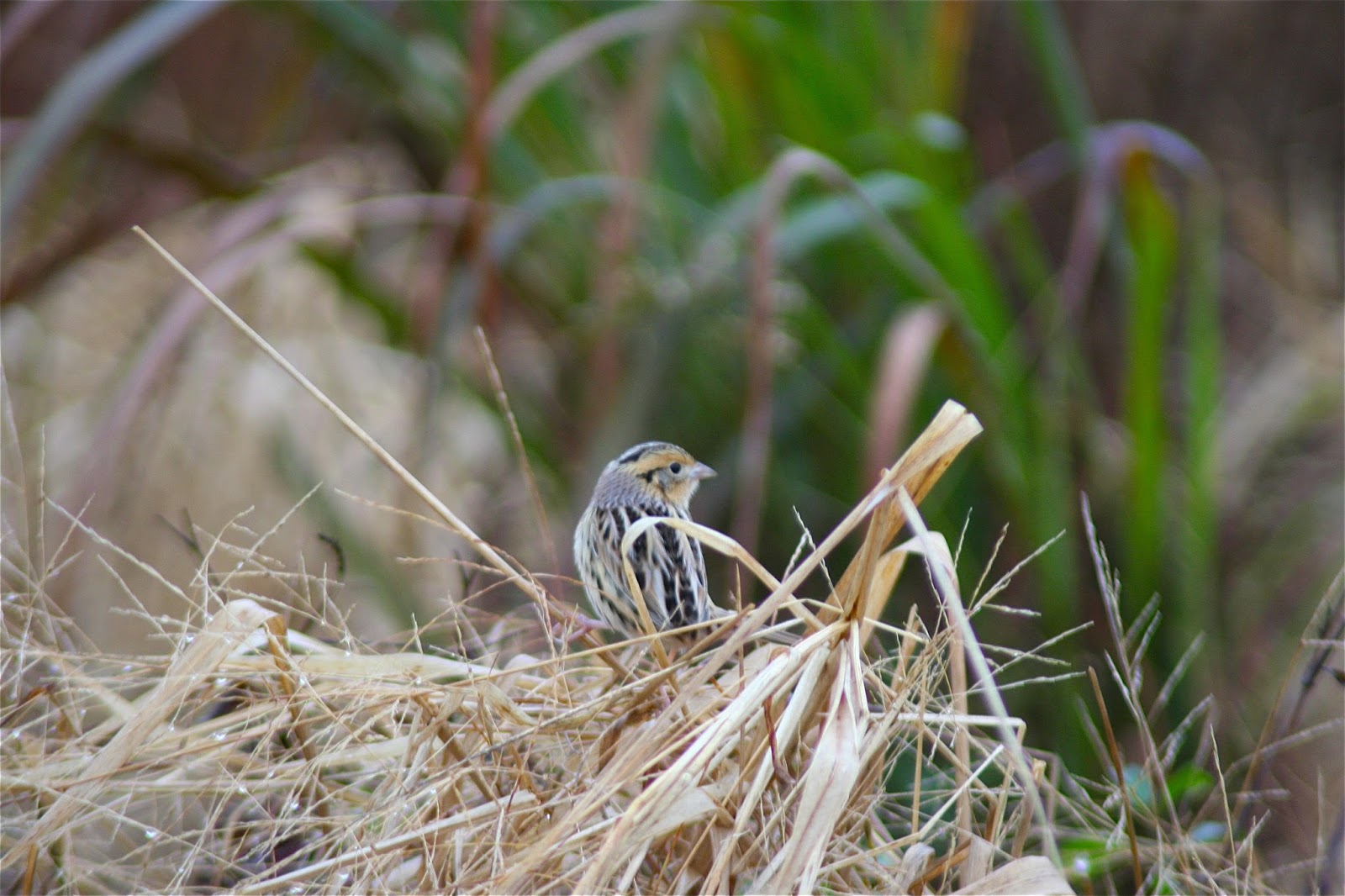
LeConte's Sparrow - Ammodramus leconteii (16Nov2014)

Is there a better North American Sparrow than LeConte's Sparrow? If there is, I don't know it.  I am not sure how to explain the LeConte's Sparrow's superiority other than to say it just looks good.  This particular bird was found at North River Farms in Carteret County, NC and was especially obliging.  This is a species that usually does not show itself well, preferring to run along the ground under heavy grasses.  So although these shots were with my old camera set up and under less than ideal lighting conditions, I am just not sure I will have better opportunities in the future.


Look at that purplish nape!

I looked up who LeConte was and why he got so many good birds named after him, and it looks as though Audubon was just being nice and naming this particular sparrow after a buddy who was really an entomologist.

Thursday, November 19, 2015

Limpkin - Aramus guarauno (29Jul2015)

You have about the same odds seeing a Limpkin in North Carolina as you do getting struck by lightning.  However, on the 29th day of July, the unlikely happened.  Of course I had help, the bird was found by someone else the day before.  I have seen Limpkins in Florida and the Bahamas but seeing a bird that is not expected in your state just kicks it up another notch.  Another thing that made this bird even sweeter, I had to haul my kayak up about 4 hours west, then kayak up a river for a couple hours.

When I got to the spot the bird was reported, it was no where to be seen.  I spoke to a local and he said he knew of small creek about a quarter mile up the river that could be good habitat for the Limpkin.  Since I have already spent half a day on the bird, I figured I might as well try. So I paddled up river. A quarter of a mile turned into a mile but I found the creek and eventually spotted the bird.  These kinds of adventures are a major part of why finding birds is so much fun.


Arctic Tern - Sterna paradisaea (16May2015)

Have you ever noticed the contradiction between the common name and latin name for Acrtic Tern?  Maybe some folks consider the arctic paradise, but it seems like a reach.  Maybe the latin name comes from the fact that these birds have perfected the Endless Summer.  For example, the Greenland population spends summer in Greenland and then migrates to the Antarctic for the Southern Hemisphere summer.  And you thought Hudsonian Godwits were the kings of migration.  Arctic Terns have been shown to migrate 56,000 miles in one year!  They are a true pelagic tern, only landing to breed, or maybe just to say hi to a birder in NC as this bird did at North Topsail Beach.


The bird was obviously exhausted but looked pretty healthy and did go back out to forage in the surf while I was there.


Note the slender blood red bill with no black tip.


Also note the short red legs.

Great bird!

Wednesday, November 18, 2015

Greater White-fronted Goose - Anser albifrons (02May2015)

Colloquially known as the "specklebelly", the Greater White-fronted Goose is good bird in North Carolina.  They are usually seen every year, but are few and far in between.  So when I received a report of a fairly tame specklebelly at Bur-Mil Park in Greensboro, I was on it like  cheap suit.

Of course this was my old camera, so I can only improve my shots of this species although this bird was especially confiding.


I can see the reason for the name.  I don't think domestics have the same belly patterns.


Saturday, November 14, 2015

Black-bellied Whistling-Duck - Dendrocygna autumnalis (19Jul2015) & (01Jul2020)

I cannot think of a more cartoonish bird than a Black-bellied Whistling-duck.  My first exposure to them was in Houston, TX.  When I started birding I used to have to go to Houston quite a bit for work, and when I saw BBWDs in the city parks, I figured they were domestic birds, much like Mallards and barnyard geese.  I soon learned BBWDs do move around and are totally wild in Houston despite being found on suburban lawns and parks.

This summer we had a group of 3 BBWDs come to Twin Lakes in Sunset Beach, NC.  I was not satisfied with the looks I had from across the lake so I found the house where the birds were and knocked on the door.  The irony was that these people didn't even really know what the ducks were and did not think they were a big deal.  In fact they were looking at me like I was the anomaly!  My family was in the car waiting to go to the beach and the people in the house were looking at me funny so I managed some quick shots and only one of them came out decent.


 We shall meet again soon my orange billed friend and I will crush you like you deserve to be crushed.

Update: In July 2020, one showed up in Wilmington at the UNCW campus and allowed me to properly photograph him/her.




Thursday, November 12, 2015

Royal Tern - Thalasseus maximus (13-Apr-2013)

Although there are bigger terns (Caspian for one), the Royal Tern is truly royalty among Sternidae.  Are they named that way because they are large and in charge?  Or is it because in breeding plumage they have a neat cap/crown?  Either way the name fits.  The below photos were taken on the East end of Ocean Isle, NC.  However, they could have been taken anywhere on the coast as these birds are distributed all over the place including the West Coast of Africa.


Royal Terns are experts at synchronized roosting. 


They are also loud as heck and even a half deaf birder can hear them.


In breeding plumage they are about as handsome as any other tern out there.  We have quite a few nesting sites in NC. 

Wednesday, November 11, 2015

White-rumped Sandpiper - Calidris fuscicollis (08Jun2013)

This little bird like quite a few other shorebirds, travels all the way from the Arctic down to the southern shores of South America and back each year.  We in North Carolina are only able to see it during migration so you best be on your game when it comes.  It is only slightly larger than the three regularly occurring "peeps" so you need to queue in on the slight differences.  The bill with orange at its base and flecking on its flanks are good field marks, but if you really want to be sure then catch it in flight.  The photo below is from my first starter camera, but I love the capture none the less.  This particular bird was on the North end of South Pond on the Outerbanks.  Until next time my little feathered friend.


Update: here are some other shots taken in 2016.