Monday, January 27, 2025

Carolina Bird Club Trip to Shack (16-18Jan2025)

Several months ago I was asked to lead a trip for the upcoming Carolina Bird Club meeting in Carteret County and I love Shackleford Banks so I signed up for that one.  I was able to wrangle Trevor S to co-lead the trip with me.  Fast forward to the week of the trip and this was the forecast:


Basically it was saying that we would have rain for the whole time!  The trip was scheduled to leave on the 10am ferry and come back at 3pm.  Rain and low temperatures on an island that has zero cover is kind of a bad idea.  Especially when you consider some participants may be elderly and more vulnerable to things like pneumonia.  The good news is everything actually turned out alright!  But before I get to that part of the post, I am just going to finish up some pics from the 16th because my last post was corrupted while I wrote it and I had to publish it prematurely before I lost everything.

So here are some photos from Ashley HS Ponds where I left off in the last post.


Mallard - one of the most ubiquitous and consequently under appreciated ducks in the world.


Snowy Egret sporting some nice black and yellow leggings.


Great Egret emitting out a mighty bellows that almost knocked me off my feet.


Turkey Vultures love this area because of the many high roosting spots and they also drink at the pond.  When you eat roadkill all day, you need to wash it down with something.


Sand Live Oak - my iNat submission for the day.


The Wiki entry on these oaks is relatively anaemic compared to its big brother the Southern Live Oak.  Sand Live Oaks tend to thrive in sandier habitats (duh!) and are scrubby and grow in thickets.  The leaves are more revolute than Souther Live Oak.  This means the leaves curl downward at the edges making the leaf more boat-like if you flip them over.


Black Vulture - they also like Ashley HS Ponds for the same reasons as the Turkeys.


Gadwall is the most common duck at this pond most of the time which is strange because they are not too plentiful elsewhere.


Wilson's Snipe - usually it is hard finding these skulkers but I saw it fly and put down so I knew where to look.


White Ibis


On Friday, I was able to finish up work by the early afternoon and decided to head up and spend the night in Morehead City so I wouldn't have to drive very early the next morning.  

The evening light was pretty good when I was driving by the Holly Shelter Gamelands entrance so I decided to pop in and try my luck.  It took a little white to find my quarry, but once I did they were very confiding.


Red-cockaded Woodpecker


Nice Bokeh!


Another TV!  This is a TV I can watch all day.


Longleaf Pine - I remembered late in the day that I hadn't done my iNat submission for the day so this important tree of Holly Shelter was a good choice.


These beauties are essential in providing the habitat that RCWPs and Bachman's Sparrows thrive in.

In the morning, I woke up early and put on some Dominik Eulberg.  


That's a mouthful!

My older brother sent me a text about this guy and I gave it a try and now it is on my Pandora rotation.  Check out this guy's website: https://m.dominik-eulberg.de/en/interviews/birdwatcher-by-day-and-by-night/

One of the interesting comments on Spotify is that Dominik Eulberg is responsible for reconciling birding and techno music.  I didn't even know they were at odds!  Try it and you will see maybe you previously gave techno a pass prematurely.  Its great music for getting amped up for a hard-core birding session!  Im kind of kidding, but also not.

My first stop in the morning was at someone's house in Morehead City who let me see their resident Bullock's Oriole.  He let me park my car in between two feeders and I didn't have to wait long.


Bullock's Oriole!


An Orange-crowned Warbler stopped by too.

A short drive later, I arrived to the Harker's Island Ferry terminal and immediately began looking for the Snow Bunting which has been hanging around.  It didn't take long to find because many of the tour participants were providing extra eyes.


Snow Bunting!


Very nice to have this outside of Dare County.

We boarded the ferry and I was pleased that we only had 10 or so participants as it would be easier to keep an eye on everyone.  However, all my fears were unfounded.  All the participants ended up being good sports and mostly dressed appropriately for the rain.  My other fear was that we wouldn't find the specialty bird of East Shackleford which is the Long-billed Curlew.  Marty W had led the same tour the day before and they didn't have any, although Marty said he was looking at pictures later and noticed there was at least one in the distance.

My initial plan was to start on the inside of the island and do a counter-clockwise loop ending at the south beach on the high tide.  However, the tide was already higher than I expected and we couldn't cross the first little channel that would take us to the marshes.  So we changed plans and started on the beach in a clockwise motion.  

After quite a slog down the beach in some slight drizzle we made it to a nice group of shorebirds but the photo ops were limited as they were quite distant and scope views were best.


Red Knots were probably the best bird and a wintering Wilson's Plover (not the one in above picture which is a Semi) was nice too.  I didn't take a pic of the Wilson's because I knew I would get those later on my beloved Mason Inlet.  We also had a Great Cormorant in the distance which some participants liked.


A Merlin ended our beach party and we headed across the dunes into the marsh.

This is where the rain really started up so my pictures are not great, but I was smart enough to be the only person with an umbrella which made looking in the scope for our target bird more comfortable.


Bingo!  Long-billed Curlew - I spotted them in the distance and got the group to follow me quickly to a better viewing spot where everyone got great looks at not one, but three LBCUs!  Hooray!  


There were plenty of Marbled Godwits too, but I couldn't find any Bar-tailed.  I bet it might still be out there, but it was difficult looking through the thousands of shorebirds in the rain.


Some of the LBCUs came quite close at one point.


Whimbrels stayed further away but I still got some passable shots.


Whimbrel


It really started to rain hard at this point so I asked everyone if they would be up to leave early and they all were so I called the ferry and they came to pick us up with no delays..  All in all, it was a very successful trip!


Friday, January 24, 2025

More Good Local Stuff (11-16Jan2025)

I am still birding "wicked hard" as they say in Rhode Island.


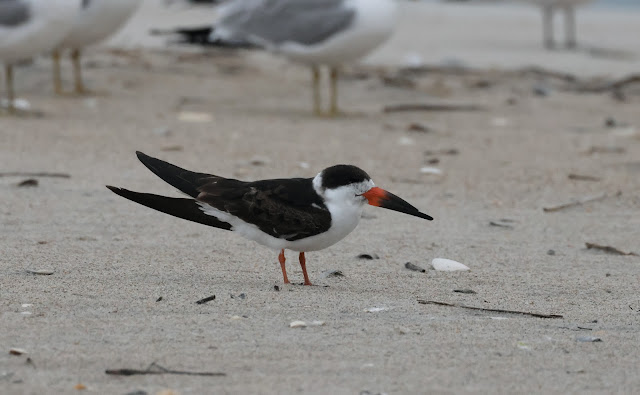
Black Skimmers are still around in good numbers as of early January, but I suspect the numbers will continue drop.


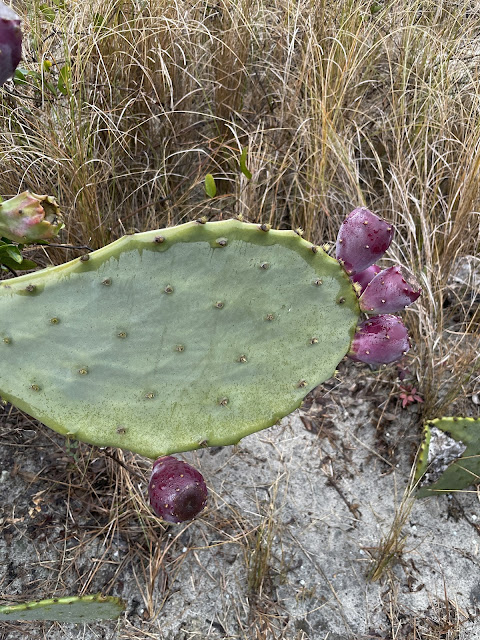
iNat submission for the day - Prickly Pear Cactus!  There are so many cool facts about Prickly Pears that are well summarized on Wiki, but I will list a few.  Obviously most people know that the fruits are edible and in fact quite delicious.  However, you need to be careful when preparing them as the fruit also have little spines that are easy to get in your fingers and then good luck trying to get them out.  Most people don't bother with them for this reason, but I do sometimes grab them as I know nothing good in life is easy.

They have a wide natural distribution all over North America and can readily be found in various coastal areas in southeastern NC including Wrightsville Beach where I saw these.  Mexicans revere this plant and use it for all kinds of things including medicinal uses, candy, dye and they even harvest the meat/pad of the cactus to mix into various dishes.  They are called Nopales and frequently they are mixed into an egg scramble.  


Blue-headed Vireo at Airlie Gardens.  I usually don't try photography when the weather is bad, but lately I have been playing with settings and have gotten a few decent shots even in totally overcast conditions.  I am hoping this will help me to make do with bad conditions when I am traveling.  If you only have a week in your travel destination, you can't really pick and choose only the good days.


Black-and-white Warbler - I have found that Blue-headed Vireos always travel with a B&W on the coast in the winter.


Brown Creeper - One of these days I will get a really good photo of these little alien looking birds.


The large black eye is what makes them look alien to me.


American Robin - an under appreciated bird with a large distribution that leads to the faulty assumption that they are always around and stick to the same areas.  However, most of the Robins we see here now are probably migrants from up north.  The Robins we see in the summer are probably migrants from further south or maybe up in the mountains.  They move around and play musical chairs with each other.


A Great Horned Owl has started nesting again in the same tree as last year in Oleander Gardens (cemetery).  It seems like a bad spot because of all the crows that fly around there, but it must be working for him/her.

Eastern Meadowlark - ILM Airport is always my go to spot every year for Meadowlarks and Shrikes.


Loggerhead Shrike


I headed over to the Battleship to see if I could get me some Rusty Blackbirds...


Rusty Blackbird - although I found them, I was totally gobsmacked to see that they had cut down a ton of good habitat for parking area "improvements".  It's really sad how Wilmington is slowly but surely losing all its good trees in favor of development or asphalt.  The blackbirds are now forced to use the marginal habitat next to the entrance road instead of the previously perfect parking area.

I decided I had unfinished business at the Battleship so I went early the next morning.


Fish Crow!  I will post the link to the audio to eBird later.  I will leave the ID challenge of separating Fish Crows from American Crows to the experts and stick to audio for my ID which is fairly easy especially when they are making their nasal uh-uh calls.


Sora!  The roadside view points for rails on the entrance road to the Battleship are few and far between but luckily this Sora was hanging out in one of them.


Another Rusty Blackbird. The adult breeding plumaged males are really striking.


Palm Warbler

After the Battleship I headed down to Twin Lakes in Sunset Beach to see what I could see.


Lots of good photo ops for Common Gallinules in various plumages.


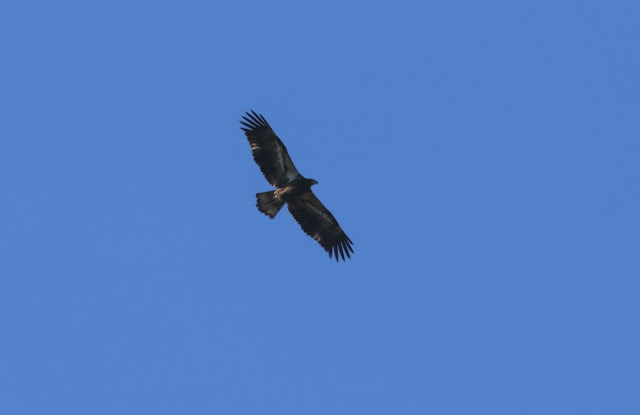
Bald Eagle - immature bird looking for easy pickings.


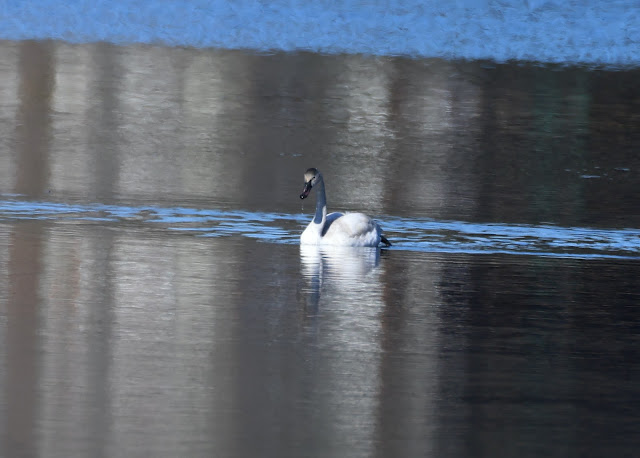
Strangely a young Tundra Swan has taken up residence.

I was spending a ton of time scanning the lakes because I was looking for leftover Cave Swallows and I did see one or two at a very far distance across the lake and couldn't manage any pics.  I suppose I will have to wait until next fall to get a photo.


Red-tailed Hawk fly-by.


Eventually I had to throw in the towel but I did manage a quick stop at the Ocean Isle Wastewater treatment plant which yielded no good photographable birds.


However, I was able to make my iNat submission for the day!  Slash Pine!  I would have easily dismissed this as a Long-leaf Pine normally.  However after some quick research I found that Slash Pine usually have needles in groups of 2-3 and the bark looks different on a young Slash Pine.  Long-leaf Pines have a dark more burly looking bark on the saplings.  They were very important as timber in the past and therefore have expanded their range north to include much of the coastal plain in NC.

Later in the evening after a lovely lunch with the wife and a game of Wingspan, I headed to the Carolina Beach Pier to see if I could obtain better photos of the continuing Harlequin Duck in good light.


The north end of CB has a ton of Eurasian Collared-Doves.


The light was much better in the afternoon with the sun to my back and the Harlequin was nice enough to come fairly close.


As did his friend the White-winged Scoter.


It was so nice out that I decided to explore further and walked north along the beach to Freeman Park which in the summer is a total mess due to all the four wheelers on the beach.  However, in the winter it is quite pleasant with only a few Bubbas.


Bonaparte's Gulls were working the surf.


Royal Terns still abound on this stretch of coast.


Brown Pelicans fly gracefully in the gloaming. 


Carolina Beach generally has much more Red-throated Loons than WB.

As the sun set I notice this interesting cloud formation was starting to line up with the moon so I walked a bit down the beach and was able to get them to line up.


A moon with a tail.

I stayed long enough to watch the sun set and tried to see if any Short-eared Owls were around but had no luck.


Telephotos are good for something other than birds!


The pier with the moon reflecting on the water.  


Early next morning at Johnnie Mercer, the light was poor but I couldn't resist snapping this Horned Grebe.

Or this Northern Gannet!

The weather was gloomy but I didn't want to quit yet so I went to the south end and was glad I did.


Pacific Loon!

This individual generated some discussion because of the excessively white flanks (think Arctic Loon), but in the end it was agreed it was a Pacific.  


Everyone knows a Red Cedar when they see one.  These beautiful local trees are obviously great for wood and the birds love the berries.

The next morning I had very little time so I headed to Wade Park which is my closest patch.


Who doesn't love American Sycamores! 

 The bark is beautiful!

The "fruit" of a Sycamore.


Eastern Phoebe.


Lunch!  I have been making Avocado Toast with eggs lately. 

On the 15th I was able to get away from work long enough for a short bird at Airlie Gardens.


Red-Shouldered Hawk surveying the parking area.


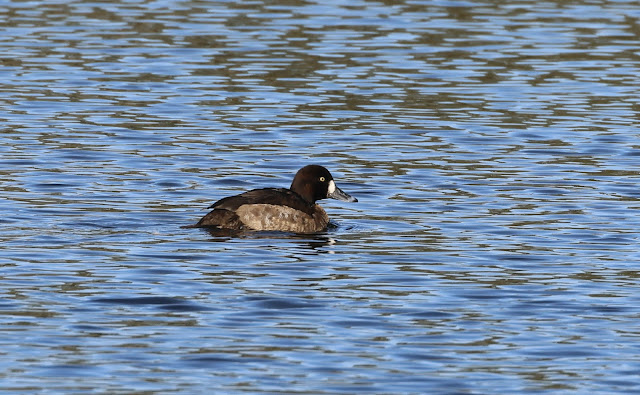
Greater Scaup!  Look at that nice round head.  No visible peak like you would see on a Lesser Scaup.

Hooded Merganser


Bald Eagle on nest.


iNat submission of the day - Spanish Moss!  Spanish Moss is neither a moss nor Spanish (from Spain).  It is an epiphyte and a bromeliad (air plant).  This means it does not parasitize the host trees which are usually Southern Live Oak or Bald Cypress.  Instead it gets its nutrients from the air and moisture and sometimes from byproduct coming from the host plant's leaves.  Birds love using it for nesting material.  I have tried to grow it on my Live Oaks at home but the birds always steal it for nests before it can establish itself.


Ruddy Duck


The early morning sun was making this Common Loon look like a Yellow-billed Loon.


But in the shade, it looked like a normal Common Loon.

While working later that day I got a text that Jesse A. had found a Wood Stork at Ashley HS so later in the afternoon I headed down.


A not so happy looking Wood Stork, clearly not enjoying the cold weather.

Meanwhile the pond at Ashley HS has had some good duck turnover...


Redhead drakes are now swimming around happily.

A Snowy Egret hunting in the shallows.