Saturday, July 5, 2025

Buff-necked Ibis (Theristicus caudatus) - 13Aug2022

The Buff-necked Ibis is another one of the 4 ibises in the genus Theristicus.  We had a ton of these hanging out in the fields right next to our Pousada (hotel) in the southern Pantanal of Brazil.  However, as is frequently the problem with the more common birds on trips to foreign lands, I tend to focus on other birds thinking I will get more chances and then end up never getting good pics at all.  I somehow only came away with two pictures of this species despite the fact that large numbers of them were roosting in the trees next to my room, making a racket first think in the morning.  


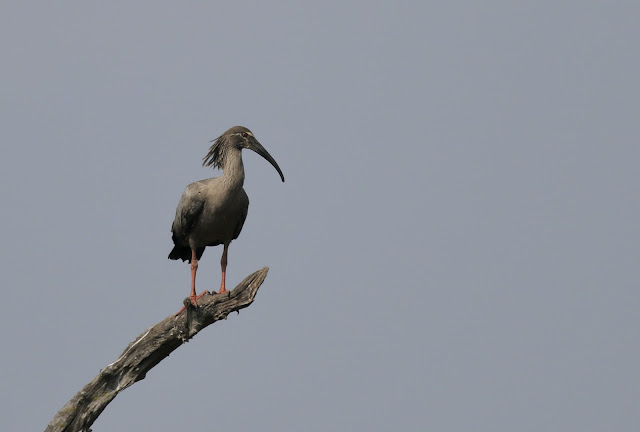
Plumbeous Ibis (Theristicus caerulescens) - 18Aug2022

Plumbeous Ibis is super cool looking, like the rasta of birds with the dread locks on the back of the head.  They are in the genus Theristicus with 3 other South American Ibises of which the Buff-necked Ibis is the closest living relative.   We got good looks at several of them in the Pantanal region of Brazil.


A begging youngster with the adult.


Friday, July 4, 2025

Green Ibis (Mesembrinibis cayennensis) - 9&21Aug2022

The Green Ibis of South and Central America is the only bird in its genus.  Although I have seen it several times in different countries, all of my half decent photos are from my first trip to Brazil.  There are quite a lot of them in the Pantanal area but we also saw them down on the coast near Sao Paulo.  The "green" is mostly an iridescence on the nape and wings but the legs and bill are also kind of greenish depending on the light.


Scarlet Ibis (Eudocimus ruber) - 31Jul2019

This retina-searing species of South America is truly a sight to behold and it usually sticks out like a sore thumb among groups of shorebirds and waders.  I still hope to get better looks when I eventually get to visit the llanos habitat in Colombia or other South American countries, but I was very happy to see this somewhat distant one in Colombia on the coast. 


Imperial Cormorant (Leucocarbo atriceps) - 21Feb2022

This is yet another "blue-eyed" shag in the genus Leucocarbo and is very similar to the Imperial Shag although their ranges don't overlap much if at all.  The Imperial Shag stays in South American waters and then once you get to Antarctica, the Antarctic Shag is the only cormorant.  All photos below are form the Antarctic peninsula. 


Imperial Shag (Leucocarbo atriceps) - 18&28Feb2022

Imperial Shag or Imperial Cormorant is another of the "blue-eyed" shags in the genus Leucocarbo, and this one really can have blue eyes, although it seems I failed to capture a really good pic of that feature.  We had them in Ushuaia and also in the crossing to Antarctica.


Magellanic Cormorant (Leucocarbo magellanicus) - 18&28Feb2022

Magellanic Cormorant, otherwise known as Rock Shag, is a denizen of Argentina, Chile and the Falklands.  Leucocarbo is a genus of black-and-white shags with 15 species including the "blue-eyed shags" although as you can see the Magellanic does not really have blue eyes. We had ours in Ushuaia before and after setting out for Antarctica.