Tuesday, September 19, 2023

Oregon Inlet Pelagics and other Stuff (26Aug - 02Sep2023)

Sorry for the radio silence folks, it's that time of year when the birds are flocking and the waves are pumping which makes it difficult to do anything but bird and surf.  That's not even accounting for my son's Cross Country meets and other life stuff.

So now I have a huge backlog of photos including 2 days of pelagics out of Oregon Inlet. So without further ado.....

The pelagic on Saturday the 26Aug was kind of ho hum from a rarity standpoint but I always enjoy spending my time on the ocean.


Red-necked Phalaropes on the way out to the gulf stream.


Great Shearwaters are much more common in the late summer than other times of the year.  They breed in the Tristan island group (Tristan da Cunha and Inaccessible Island) in the southern Atlantic which is basically halfway between Uruguay and South Africa.  Talk about out there!  How amazing are seabirds??!!


Audubon's Shearwaters are Sargassum specialists that feed on the critters that hang out and make their living in the floating weed.  The above one was photographed on the 26th, but the below one was on the 27th.
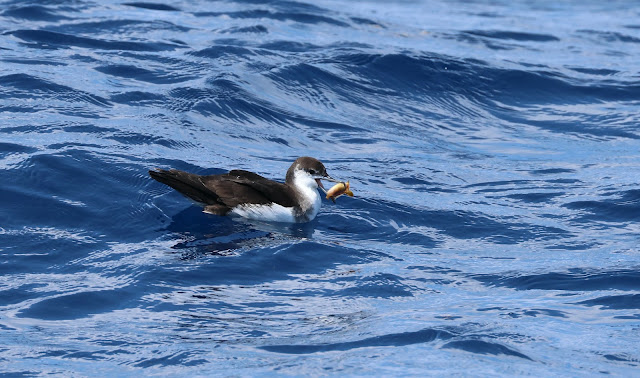

Here you can see one that caught a nice sized Sargassum Fish or some other critter.


Cory's Shearwater - hopefully this species will be split in eBird someday soon to include the Scopoli's sub-species as a separate species.  The Scopoli's sub-species breeds in the Mediterranean but then makes its living in the Atlantic.  I am not sure if this is a Scopoli's, it is easier to ID then in flight.


Band-rumped Storm-petrel - we only had a few of these over the course of two days.


Band-rumped SP


Usually this time of year we get a ton of Black-capped Petrels, but I think they like a good wind and we had relatively light winds.


Even the Wilson's SPs were in low numbers both days.


Loggerhead Turtle!  These are truly huge turtles!

Fairly early on the second day, we ran into a nice raft of shearwaters and other seabirds including....


South Polar Skuas


A Masked Booby!


Sooty Terns were abundant including these snazzy juvenile plumaged birds.


Scopoli's Shearwater - notice the white "finger tips" are extensive. The nominate sub-species has more dark feathering in the primary tips on the underside of the wing.


Here is one of the nominate sub-species typical of most Cory's Shearwaters. Note the dark primary tips.

One of the highlights of both days were the mammalian sightings. This Cuvier's Beaked Whale was a lifer for me, I think.  I previously had seen Gervais' Beaked Whales.  These are some cool cetaceans!  They dive deeper than any other whales.  They have been recorded diving up to 10,000 feet!  That's insane.


I guess you need a huge blow-hole when you dive so deep.  Not sure why the fins on the different whales I photographed look so different.  I think maybe this is an older male that has seen some wear and tear on his dorsal fin.

This young Bridled Tern was a beauty with all the cool scalloping on the upper wing.


A Sooty Tern offering a nice view of the white outer retrices (tail feathers).


Audubon's Shearwater with Sargassum Fish.


Sooty Tern


Later in the day we found why the Black-capped were not obliging us with great views, they were just sitting on the water.  Maybe they had a nice night of full moon fishing and were keen to just float in the low winds.


One of our last birds was this Trindade Petrel that flew in the distance and never really gave good looks.

Back home I tried birding a couple times, but it was still hot and slow.


Needham's Skimmer - when the birding is slow, go for the Odes (Dragonflies and Damselflies).

The weekend after the pelagic was also the weekend after Hurricane Idalia which left us relatively unscathed in Wilmington, but did end up giving us some storm birds.  This storm came up from off the coast of the Yucatan where huge colonies of American Flamingos live.  These colonies are known to get up and move to Cuba sometimes especially before or after storm events.  The prevailing theory is that a bunch of flamingos were relocating from the Yucatan to Cuba when they got caught in Idalia's winds.  Some folks have been able to read bands on the birds legs confirming they are from the Yucatan population.


Picture courtesy of ABA.org.

Flamingos were being found in Florida and as far afield as Ohio.  So Jeff Lewis of Dare County was smart and went looking for them at Pea Island and I am glad he did.  He found a flock of 11 at south pond on Pea Island.  Off I went, knowing that some storm birds don't stick around long.  I made the 5 hour drive only to find out the birds had flew! You can imagine my state of mind.  However, I collaborated with a group of other birders to look further afield and before long got a notification that they had been found out in the sound a good ways out from the Split Pea bridge.  

I got several different looks but they were far out and not conducive to photography.


Here are the 11 American Flamingos flying out over the sound near Split Pea.


Here is a picture I took in Cuba in 2017.


And one I took from the Yucatan in 2019.

Very cool.  As I write this, they are still out in the sound near Split Pea but most folks are getting long scope views.  It would be cool to bring a kayak out there and get some better looks without getting to close so as to not bother them.

I have one more post to write for some county birding I did last week, but I will save that for when I have some more material to add.


Sunday, August 20, 2023

Terns and Cuckoos in The Land of DeSantis (18-19Aug2023)

Dear readers and oglers, my deepest apologies for the radio silence.  About a month ago I finally contracted Covid courtesy of my youngest son.  That effectively meant I was too sick to bird and was quarantining myself until I was confident that I was no longer contagious.  I spent many hours catching up on Netflix and curating some of my old photos and working in the yard.

Last week I was pretty much totally recovered and was itching to get out and about despite the ridiculously high temps.  I made some small forays to the beach and Airlie Gardens but it was so hot all the birds were either hiding in the shade or dead.  Let's hope it was the former.   I was checking the American Airlines website and saw that I could use some of my old miles to fly to Fort Myers in Florida so I booked it and took Friday off from work.  For those of you not following the ABA Rarities reports, a Large-billed Tern from South America has been hanging out next to a gold course in Naples for the past month or so.  


I don't typically chase rarities on a plane, but this was one was so reliable, seemingly easy to find and convenient.

Friday morning I headed out to the Eagles Lakes Community Park and started looking for the tern.  It had been seen foraging in a pond next to the park, but also at some little sandy spits next to the adjacent golf course.  The pond next to the park was hosting 3 different species of terns feeding on small fish, but there was no sign of the Large-billed. 

Some of the Royal Terns had a ton of black on the dorsal side of the primaries which made me do double-takes, but I had seen Large-billed Terns in Brazil and Colombia and knew when I saw it flying it would stick out like a sore thumb.


It was so hot that I was sweating constantly, but I couldn't replace fluids because this sign said no drinking.  This Anhinga looked relatively hydrated so not sure if they sign was only for humans.    


Caspian Terns were getting in on the action too.


Sandwich Terns too.

I explored the neighboring golf course ponds but no cigar.  On the way back to my car I was passing the community park lake again and Bingo!


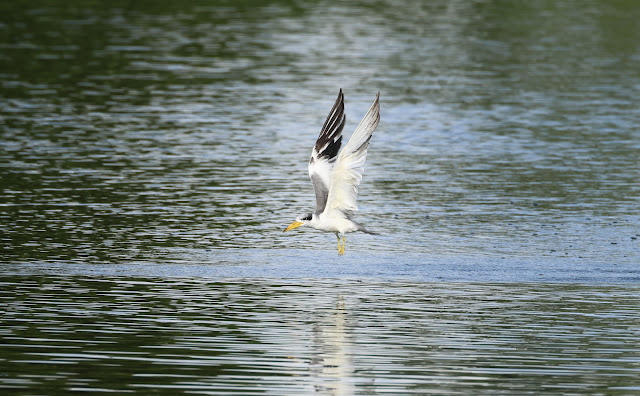
Large-billed Tern!  No mistaking that pattern. Some other folks showed up and I got them on the bird.


Even from underneath the dark tail and dingy underwings made it easy to pick out.


I watched it forage for about 30 minutes until I couldn't take the heat anymore and was thoroughly soaked.  


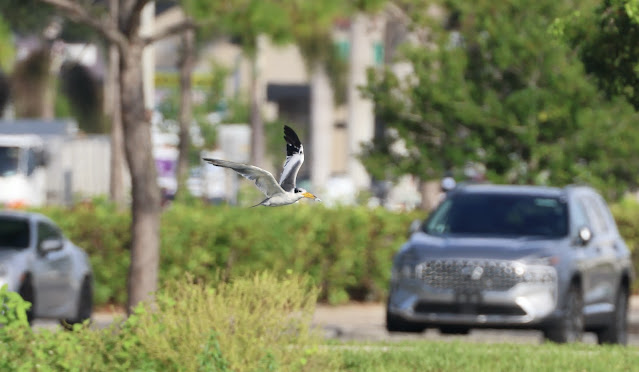
I think that is my Hyundai Tucson rental behind the tern!  I got it for $99 for two days.

Even though I took Friday off, I had some work to do so I worked for most of the hottest part of the day in the hotel room.  In the afternoon I went out to explore some parts of Florida I haven't seen yet.  I started with Marco Island, specifically Tigertail Beach which had some good eBird reports.  I was a little annoyed to find legions of Floridians on pool floats in the lagoon at Tigertail which meant no birds.  The lady at the park entrance said that the lagoon was dredged which ruined most of the good shorebird habitat.  I decided I couldn't drive all the way there without exploring some more so I made the half mile death march out to the beach to check on some of the distant flocks in between the masses of beach goers.


Black Tern


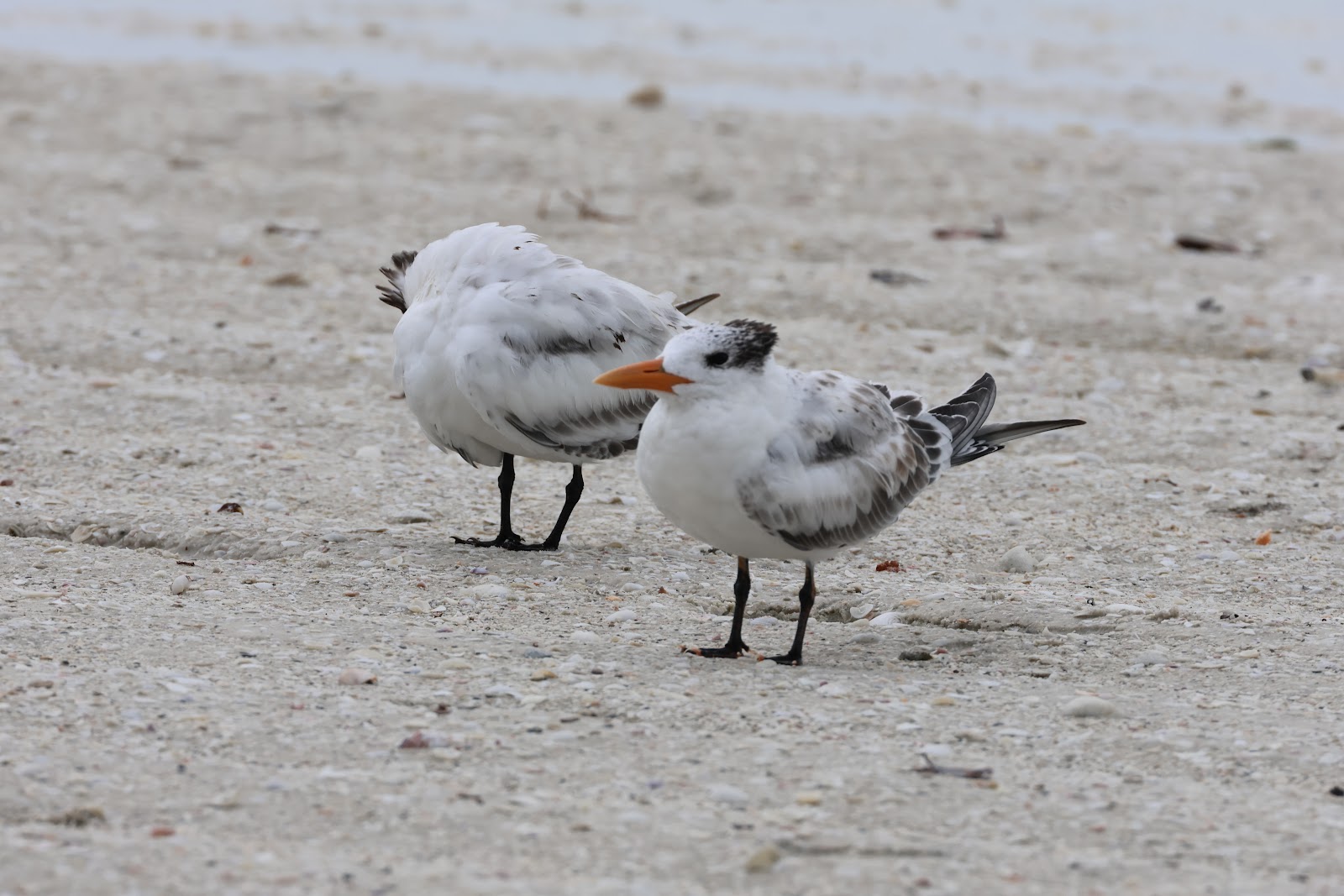
The majority of terns were Royals in all kinds of plumage phases.


Usually when you see dark carpals on a tern its a Common, but apparently Sandwich's also have them as juveniles.


This Royal Tern had some pigment issues but it looked pretty cool.

Snazzy looking Royal juvenile.


Young Least Terns like to do Stint impersonations.


Red Knot


Black Tern


I had soaked through my shirt again so I huffed it back to the air-conditioning in my Tucson.  The afternoon ended up being a big wash.  I drove inland in a big loop hoping to find Snail Kites and/or Short-tailed Hawks but came up empty.

In the morning, I checked out of my hotel and headed north to JN Ding Darling State Park on Sanibel Island near Fort Myers.   My primary target was Mangrove Cuckoo which is pretty tough to get in the ABA area although that park is a pretty good place for them according to eBird.  I saw a handful of recent reports and none elsewhere in southwest Florida so it was a no-brainer.  Sanibel is still recovering from Hurricane Ian that pretty much wiped it clean in 2022.  Here is a video I found online that shows the devastation.

sanibel hurricane 2022

A full year later, much of the mangroves are still in the process of recovering but I was able to find a few birds.


Roseate Spoonbill 


I've never seen so many Tricolored Herons - they were everywhere.


Prairie Warbler - I got out and walked around a bunch of times but would have to retreat into the AC every  20-30 minutes.  The Wildlife Drive through the park is one-way and about 2-3 miles long.  I drove it slow checking for my target - Mangrove Cuckoo.  I made it all the way to the end with little to show for it but ran into a dutch couple and they told me they had seen the cuckoo about a mile after the entrance.  I was getting short on time but I just had to try the loop again.  I am glad I did!  About 1.5 miles in, I heard a Mangrove Cuckoo and then it was just a matter of time before I found them.


I ended up having two of them just chilling feet away from me and I had to step back to shoot them.


What a great way to end the trip.  I headed back to the airport and made my fight with no problems!  If only all chases could be this successful!  If that Steller's Sea Eagle comes back to Maine in the winter, I think that will be worthy of a chase.